Problemas resueltos
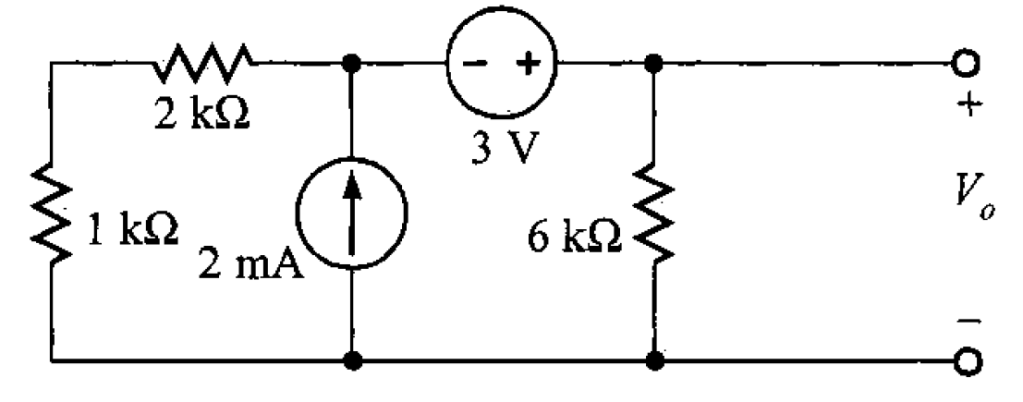
Problema 1. Encontrar 
Primer método. Utilizando el teorema de Thévenin.
Solución. Para determinar el circuito equivalente de Thévenin se abre la red en la carga de 6 kΩ (figura 2).

La LKV indica que el voltaje en circuito abierto, 


Entonces,


Después, todas las fuentes de corriente del circuito se cambian a circuitos abiertos mientras que las fuentes de voltaje se cambian a cortocircuitos; con esto se puede hallar la resistencia equivalente de Thévenin (figura 3).


Luego, se conecta el circuito equivalente de Thévenin formado por 

Por último, por divisor de voltaje, se calcula el valor de


Segundo método. Utilizando el teorema de Norton.
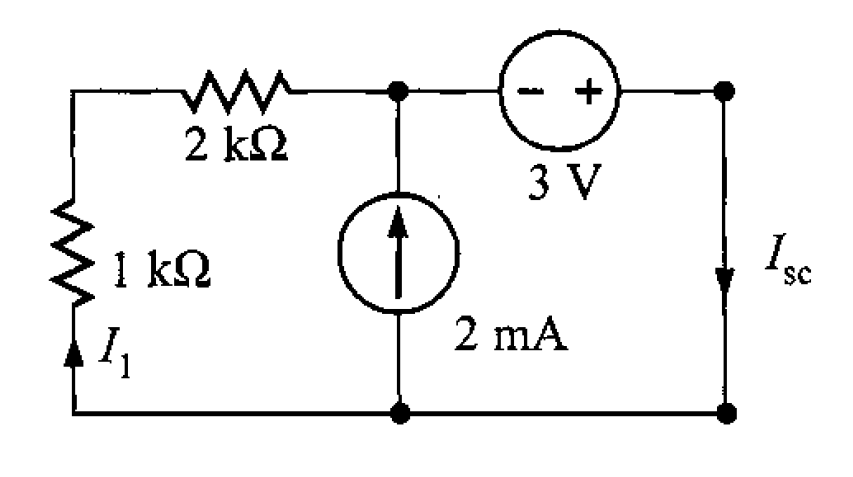
Solución. Para el circuito equivalente de Norton en las terminales de la carga, se debe calcular la corriente de cortocircuito, como se muestra en la figura 5. Se observa que el cortocircuito hace que la fuente de 3 V quede directamente entre los resistores y la fuente de corriente (esto es, en paralelo con dichos elementos).
Entonces, 


Aplicando la LKC en la figura 5, resulta


El valor de 

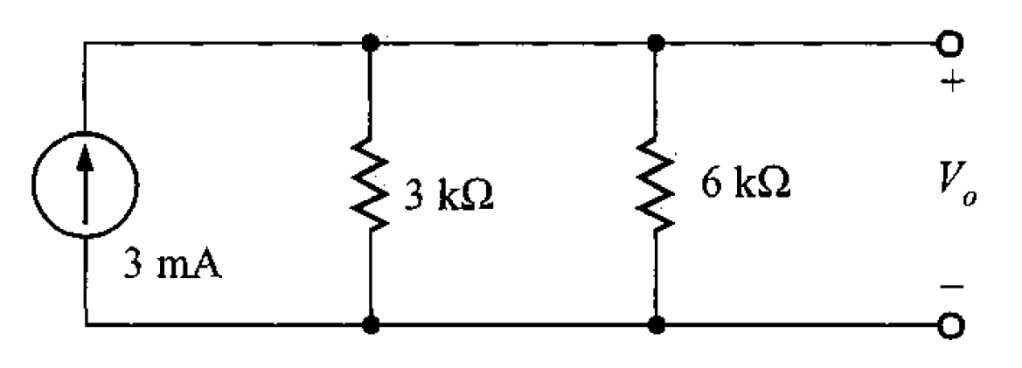
Por ley de Ohm, se obtiene el valor de
![\displaystyle V_o = \left[\frac{(3 \ \text{k})(6 \ \text{k})}{3 \ \text{k} + 6 \ \text{k}} \right] (3 \ \text{m})](https://s0.wp.com/latex.php?latex=%5Cdisplaystyle+V_o+%3D+%5Cleft%5B%5Cfrac%7B%283+%5C+%5Ctext%7Bk%7D%29%286+%5C+%5Ctext%7Bk%7D%29%7D%7B3+%5C+%5Ctext%7Bk%7D+%2B+6+%5C+%5Ctext%7Bk%7D%7D+%5Cright%5D+%283+%5C+%5Ctext%7Bm%7D%29&bg=ffffff&fg=192930&s=0&c=20201002)

Problema 2. Hallar el valor de

Primer método. Utilizando el teorema de Thévenin.
Solución. Se abre la red en la carga de 6 kΩ; esto genera dos mallas, como se observa en la figura 8.

La ecuación para la primera corriente de malla es


Y la segunda corriente de malla es

Teniendo las ecuaciones
 | (1) |
 | (2) |
Sustituyendo la ecuación (2) en (1), resulta que


Una vez calculado los valores de las corrientes 


Haciendo que la fuente de voltaje se comporte como un cortocircuito y que la fuente de corriente como un circuito abierto, se tiene lo siguiente en la figura 9.

Con esto es posible determinar la resistencia Thévenin y es


Conectando el circuito equivalente de Thévenin a la carga se produce el circuito mostrado en la figura 10.

Usando la división de voltaje, se obtiene el resultado final de


Segundo método. Utilizando el teorema de Norton.
Solución. Para ello, es necesario que en las terminales de la carga, se determine la corriente de cortocircuito, como se ilustra en la figura 11.
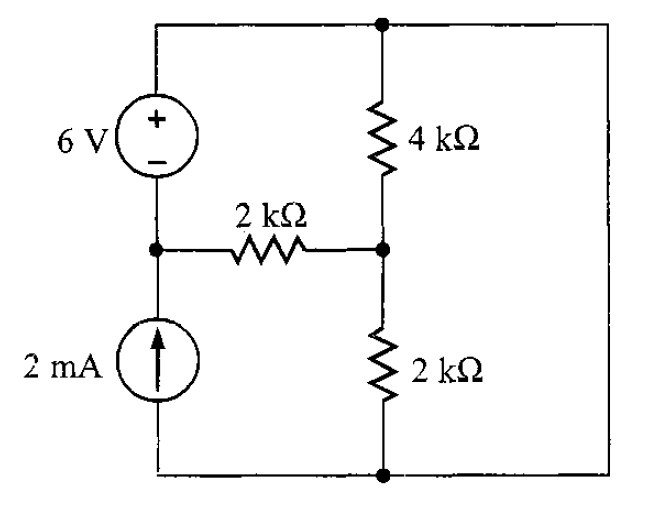
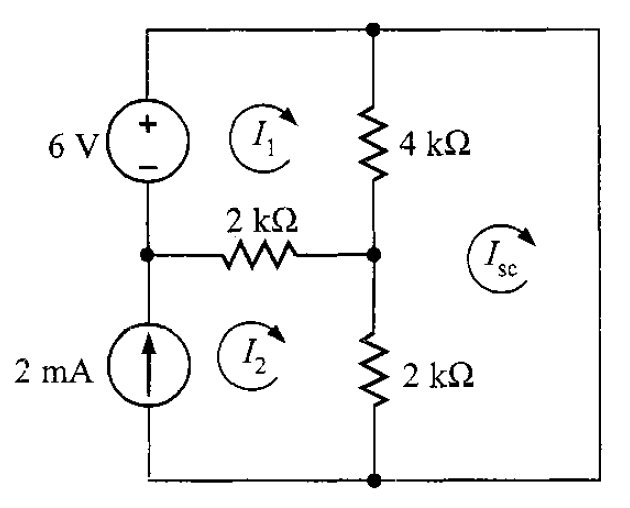
En la figura 12 se observa que se han localizado las corrientes de malla y pueden ser hallas utilizando la LKV. En la primera corriente de malla, su ecuación es


La ecuación de la segunda corriente de malla es
y en le caso de la tercera corriente de malla


Las ecuaciones obtenidas anteriormente son
 | (1) |
| (2) |
 | (3) |
Sustituyendo de la ecuación (2) en (1) y (3), se reduce a dos ecuaciones
 | |
 |
Simplificando
 | (4) |
 | (5) |
Con esto sólo es necesario determinar
![\displaystyle \left[\begin{matrix} 6 \ \text{k} & -4\ \text{k} \\ -4 \ \text{k} & 6 \ \text{k} \end{matrix} \right] \left[\begin{matrix} I_1 \\ I_{sc} \end{matrix} \right] = \left[\begin{matrix} 10 \\ 4 \end{matrix} \right]](https://s0.wp.com/latex.php?latex=%5Cdisplaystyle+%5Cleft%5B%5Cbegin%7Bmatrix%7D+6+%5C+%5Ctext%7Bk%7D+%26+-4%5C+%5Ctext%7Bk%7D+%5C%5C+-4+%5C+%5Ctext%7Bk%7D+%26+6+%5C+%5Ctext%7Bk%7D+%5Cend%7Bmatrix%7D+%5Cright%5D+%5Cleft%5B%5Cbegin%7Bmatrix%7D+I_1+%5C%5C+I_%7Bsc%7D+%5Cend%7Bmatrix%7D+%5Cright%5D+%3D+%5Cleft%5B%5Cbegin%7Bmatrix%7D+10+%5C%5C+4+%5Cend%7Bmatrix%7D+%5Cright%5D&bg=ffffff&fg=192930&s=0&c=20201002)
![\displaystyle \left[\begin{matrix} I_1 \\ I_{sc} \end{matrix} \right] = {\left[\begin{matrix} 6 \ \text{k} & -4\ \text{k} \\ -4 \ \text{k} & 6 \ \text{k} \end{matrix} \right]}^{-1} \left[\begin{matrix} 10 \\ 4 \end{matrix} \right]](https://s0.wp.com/latex.php?latex=%5Cdisplaystyle+%5Cleft%5B%5Cbegin%7Bmatrix%7D+I_1+%5C%5C+I_%7Bsc%7D+%5Cend%7Bmatrix%7D+%5Cright%5D+%3D+%7B%5Cleft%5B%5Cbegin%7Bmatrix%7D+6+%5C+%5Ctext%7Bk%7D+%26+-4%5C+%5Ctext%7Bk%7D+%5C%5C+-4+%5C+%5Ctext%7Bk%7D+%26+6+%5C+%5Ctext%7Bk%7D+%5Cend%7Bmatrix%7D+%5Cright%5D%7D%5E%7B-1%7D+%5Cleft%5B%5Cbegin%7Bmatrix%7D+10+%5C%5C+4+%5Cend%7Bmatrix%7D+%5Cright%5D&bg=ffffff&fg=192930&s=0&c=20201002)
![\displaystyle \left[\begin{matrix} I_1 \\ I_{sc} \end{matrix} \right] = \left(\frac{1}{20 \ \text{k}^2} \right) \left[\begin{matrix} 6 \ \text{k} & 4\ \text{k} \\ 4 \ \text{k} & 6 \ \text{k} \end{matrix} \right] \left[\begin{matrix} 10 \\ 4 \end{matrix} \right]](https://s0.wp.com/latex.php?latex=%5Cdisplaystyle+%5Cleft%5B%5Cbegin%7Bmatrix%7D+I_1+%5C%5C+I_%7Bsc%7D+%5Cend%7Bmatrix%7D+%5Cright%5D+%3D+%5Cleft%28%5Cfrac%7B1%7D%7B20+%5C+%5Ctext%7Bk%7D%5E2%7D+%5Cright%29+%5Cleft%5B%5Cbegin%7Bmatrix%7D+6+%5C+%5Ctext%7Bk%7D+%26+4%5C+%5Ctext%7Bk%7D+%5C%5C+4+%5C+%5Ctext%7Bk%7D+%26+6+%5C+%5Ctext%7Bk%7D+%5Cend%7Bmatrix%7D+%5Cright%5D+%5Cleft%5B%5Cbegin%7Bmatrix%7D+10+%5C%5C+4+%5Cend%7Bmatrix%7D+%5Cright%5D&bg=ffffff&fg=192930&s=0&c=20201002)
![\displaystyle \left[\begin{matrix} I_1 \\ I_{sc} \end{matrix} \right] = \left[\begin{matrix} \left(\frac{1}{20 \ \text{k}^2} \right)(6 \ \text{k}) & \left(\frac{1}{20 \ \text{k}^2} \right)(4\ \text{k}) \\ \left(\frac{1}{20 \ \text{k}^2} \right)(4 \ \text{k}) & \left(\frac{1}{20 \ \text{k}^2} \right)(6 \ \text{k}) \end{matrix} \right] \left[\begin{matrix} 10 \\ 4 \end{matrix} \right]](https://s0.wp.com/latex.php?latex=%5Cdisplaystyle+%5Cleft%5B%5Cbegin%7Bmatrix%7D+I_1+%5C%5C+I_%7Bsc%7D+%5Cend%7Bmatrix%7D+%5Cright%5D+%3D++%5Cleft%5B%5Cbegin%7Bmatrix%7D+%5Cleft%28%5Cfrac%7B1%7D%7B20+%5C+%5Ctext%7Bk%7D%5E2%7D+%5Cright%29%286+%5C+%5Ctext%7Bk%7D%29+%26+%5Cleft%28%5Cfrac%7B1%7D%7B20+%5C+%5Ctext%7Bk%7D%5E2%7D+%5Cright%29%284%5C+%5Ctext%7Bk%7D%29+%5C%5C+%5Cleft%28%5Cfrac%7B1%7D%7B20+%5C+%5Ctext%7Bk%7D%5E2%7D+%5Cright%29%284+%5C+%5Ctext%7Bk%7D%29+%26+%5Cleft%28%5Cfrac%7B1%7D%7B20+%5C+%5Ctext%7Bk%7D%5E2%7D+%5Cright%29%286+%5C+%5Ctext%7Bk%7D%29+%5Cend%7Bmatrix%7D+%5Cright%5D+%5Cleft%5B%5Cbegin%7Bmatrix%7D+10+%5C%5C+4+%5Cend%7Bmatrix%7D+%5Cright%5D&bg=ffffff&fg=192930&s=0&c=20201002)
![\displaystyle \left[\begin{matrix} I_1 \\ I_{sc} \end{matrix} \right] = \left[\begin{matrix} \frac{6}{20 \ \text{k}} & \frac{4}{20 \ \text{k}} \\ \frac{4}{20 \ \text{k}} &\frac{6}{20 \ \text{k}} \end{matrix} \right] \left[\begin{matrix} 10 \\ 4 \end{matrix} \right] = \left[\begin{matrix} \frac{6}{20 \times 10^{3}} & \frac{4}{20 \times 10^{3}} \\ \frac{4}{20 \times 10^{3}} &\frac{6}{20 \times 10^{3}} \end{matrix} \right] \left[\begin{matrix} 10 \\ 4 \end{matrix} \right]](https://s0.wp.com/latex.php?latex=%5Cdisplaystyle+%5Cleft%5B%5Cbegin%7Bmatrix%7D+I_1+%5C%5C+I_%7Bsc%7D+%5Cend%7Bmatrix%7D+%5Cright%5D+%3D++%5Cleft%5B%5Cbegin%7Bmatrix%7D+%5Cfrac%7B6%7D%7B20+%5C+%5Ctext%7Bk%7D%7D+%26+%5Cfrac%7B4%7D%7B20+%5C+%5Ctext%7Bk%7D%7D+%5C%5C+%5Cfrac%7B4%7D%7B20+%5C+%5Ctext%7Bk%7D%7D+%26%5Cfrac%7B6%7D%7B20+%5C+%5Ctext%7Bk%7D%7D+%5Cend%7Bmatrix%7D+%5Cright%5D+%5Cleft%5B%5Cbegin%7Bmatrix%7D+10+%5C%5C+4+%5Cend%7Bmatrix%7D+%5Cright%5D+%3D++%5Cleft%5B%5Cbegin%7Bmatrix%7D+%5Cfrac%7B6%7D%7B20+%5Ctimes+10%5E%7B3%7D%7D+%26+%5Cfrac%7B4%7D%7B20+%5Ctimes+10%5E%7B3%7D%7D+%5C%5C+%5Cfrac%7B4%7D%7B20+%5Ctimes+10%5E%7B3%7D%7D+%26%5Cfrac%7B6%7D%7B20+%5Ctimes+10%5E%7B3%7D%7D+%5Cend%7Bmatrix%7D+%5Cright%5D+%5Cleft%5B%5Cbegin%7Bmatrix%7D+10+%5C%5C+4+%5Cend%7Bmatrix%7D+%5Cright%5D&bg=ffffff&fg=192930&s=0&c=20201002)
![\displaystyle \left[\begin{matrix} I_1 \\ I_{sc} \end{matrix} \right] = \left[\begin{matrix} \frac{3}{10} \times 10^{-3} & \frac{1}{5} \times 10^{-3} \\ \\ \frac{1}{5} \times 10^{-3} &\frac{3}{10} \times 10^{-3} \end{matrix} \right] \left[\begin{matrix} 10 \\ 4 \end{matrix} \right] = \left[\begin{matrix} \left(\frac{3}{10} \times 10^{-3} \right)(10) + \left(\frac{1}{5} \times 10^{-3} \right)(4) \\ \\ \left(\frac{1}{5} \times 10^{-3} \right)(10) + \left(\frac{3}{10} \times 10^{-3}\right)(4) \end{matrix} \right]](https://s0.wp.com/latex.php?latex=%5Cdisplaystyle+%5Cleft%5B%5Cbegin%7Bmatrix%7D+I_1+%5C%5C+I_%7Bsc%7D+%5Cend%7Bmatrix%7D+%5Cright%5D+%3D++%5Cleft%5B%5Cbegin%7Bmatrix%7D+%5Cfrac%7B3%7D%7B10%7D+%5Ctimes+10%5E%7B-3%7D+%26+%5Cfrac%7B1%7D%7B5%7D+%5Ctimes+10%5E%7B-3%7D+%5C%5C+%5C%5C+%5Cfrac%7B1%7D%7B5%7D+%5Ctimes+10%5E%7B-3%7D+%26%5Cfrac%7B3%7D%7B10%7D+%5Ctimes+10%5E%7B-3%7D+%5Cend%7Bmatrix%7D+%5Cright%5D+%5Cleft%5B%5Cbegin%7Bmatrix%7D+10+%5C%5C+4+%5Cend%7Bmatrix%7D+%5Cright%5D+%3D++%5Cleft%5B%5Cbegin%7Bmatrix%7D+%5Cleft%28%5Cfrac%7B3%7D%7B10%7D+%5Ctimes+10%5E%7B-3%7D+%5Cright%29%2810%29+%2B+%5Cleft%28%5Cfrac%7B1%7D%7B5%7D+%5Ctimes+10%5E%7B-3%7D+%5Cright%29%284%29+%5C%5C+%5C%5C+%5Cleft%28%5Cfrac%7B1%7D%7B5%7D+%5Ctimes+10%5E%7B-3%7D+%5Cright%29%2810%29+%2B+%5Cleft%28%5Cfrac%7B3%7D%7B10%7D+%5Ctimes+10%5E%7B-3%7D%5Cright%29%284%29+%5Cend%7Bmatrix%7D+%5Cright%5D&bg=ffffff&fg=192930&s=0&c=20201002)
![\displaystyle \left[\begin{matrix} I_1 \\ I_{sc} \end{matrix} \right] = \left[\begin{matrix} 3 \times 10^{-3} + \frac{4}{5} \times 10^{-3} \\ \\ 2 \times 10^{-3} + \frac{6}{5} \times 10^{-3} \end{matrix} \right] = \left[\begin{matrix} \frac{19}{5} \times 10^{-3} \\ \\ \frac{16}{5} \times 10^{-3} \end{matrix} \right] = \left[\begin{matrix} \frac{19}{5} \\ \\ \frac{16}{5} \end{matrix} \right] \times 10^{-3}](https://s0.wp.com/latex.php?latex=%5Cdisplaystyle+%5Cleft%5B%5Cbegin%7Bmatrix%7D+I_1+%5C%5C+I_%7Bsc%7D+%5Cend%7Bmatrix%7D+%5Cright%5D+%3D++%5Cleft%5B%5Cbegin%7Bmatrix%7D+3+%5Ctimes+10%5E%7B-3%7D+%2B+%5Cfrac%7B4%7D%7B5%7D+%5Ctimes+10%5E%7B-3%7D+%5C%5C+%5C%5C+2+%5Ctimes+10%5E%7B-3%7D+%2B+%5Cfrac%7B6%7D%7B5%7D+%5Ctimes+10%5E%7B-3%7D+%5Cend%7Bmatrix%7D+%5Cright%5D+%3D++%5Cleft%5B%5Cbegin%7Bmatrix%7D+%5Cfrac%7B19%7D%7B5%7D+%5Ctimes+10%5E%7B-3%7D+%5C%5C+%5C%5C+%5Cfrac%7B16%7D%7B5%7D+%5Ctimes+10%5E%7B-3%7D+%5Cend%7Bmatrix%7D+%5Cright%5D+%3D++%5Cleft%5B%5Cbegin%7Bmatrix%7D+%5Cfrac%7B19%7D%7B5%7D+%5C%5C+%5C%5C+%5Cfrac%7B16%7D%7B5%7D+%5Cend%7Bmatrix%7D+%5Cright%5D+%5Ctimes+10%5E%7B-3%7D&bg=ffffff&fg=192930&s=0&c=20201002)
![\displaystyle \left[\begin{matrix} I_1 \\ I_{sc} \end{matrix} \right] = \left[\begin{matrix} \frac{19}{5} \\ \\ \frac{16}{5} \end{matrix} \right] \ \text{mA}](https://s0.wp.com/latex.php?latex=%5Cdisplaystyle+%5Cleft%5B%5Cbegin%7Bmatrix%7D+I_1+%5C%5C+I_%7Bsc%7D+%5Cend%7Bmatrix%7D+%5Cright%5D+%3D++%5Cleft%5B%5Cbegin%7Bmatrix%7D+%5Cfrac%7B19%7D%7B5%7D+%5C%5C+%5C%5C+%5Cfrac%7B16%7D%7B5%7D+%5Cend%7Bmatrix%7D+%5Cright%5D+%5C+%5Ctext%7BmA%7D&bg=ffffff&fg=192930&s=0&c=20201002)
Entonces las corrientes son 

La resistencia Thévenin se determinó cuando las fuentes de voltaje y corriente se volvieron nulas cuando se estaba encontrando el circuito equivalente de Thévenin. Entonces,
Por último, se conecta el circuito equivalente de Norton a la carga que fue separada en un principio; el circuito esperado se muestra en la figura 13.
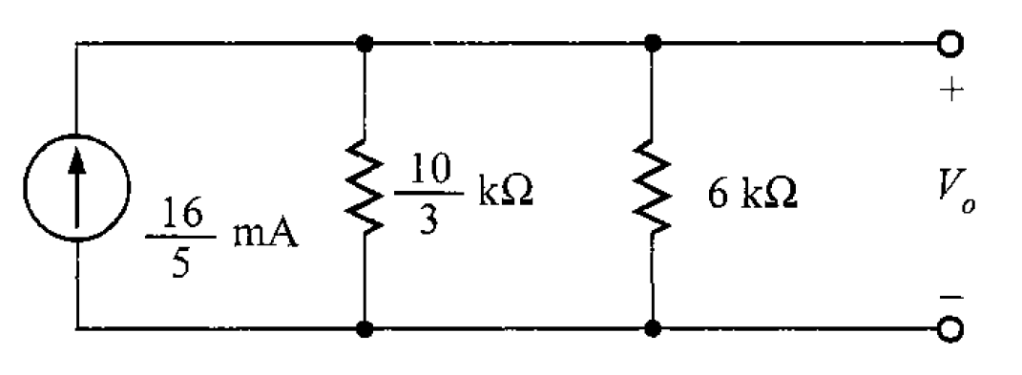
Finalmente, por ley de Ohm, se puede calcular el valor de
![\displaystyle V_o = \left[\frac{\left(\frac{10}{3} \ \text{k} \right) \left(6 \ \text{k} \right)}{\frac{10}{3} \ \text{k} + 6 \ \text{k}} \right] \left(\frac{16}{5} \ \text{m} \right)](https://s0.wp.com/latex.php?latex=%5Cdisplaystyle+V_o+%3D+%5Cleft%5B%5Cfrac%7B%5Cleft%28%5Cfrac%7B10%7D%7B3%7D+%5C+%5Ctext%7Bk%7D+%5Cright%29+%5Cleft%286+%5C+%5Ctext%7Bk%7D+%5Cright%29%7D%7B%5Cfrac%7B10%7D%7B3%7D+%5C+%5Ctext%7Bk%7D+%2B+6+%5C+%5Ctext%7Bk%7D%7D+%5Cright%5D+%5Cleft%28%5Cfrac%7B16%7D%7B5%7D+%5C+%5Ctext%7Bm%7D+%5Cright%29&bg=ffffff&fg=192930&s=0&c=20201002)


 Herramientas de cálculo