Fórmula de inversión compleja y el contorno de Bromwich. Laplace.
Introducción
Si , entonces está dada por
– – – (1)
donde y para . Este resultado se llama la inversión integral compleja o fórmula de inversión compleja. Tambipen se conoce como la fórmula integral de Bromwich. Este resultado ofrece un método directo para obtener la transformada inversa de Laplace de una función dada .
La integración de la ecuación (1) se realiza a lo largo de un segmento del plano complejo donde . El número real se escoge en tal forma que quede a la derecha de todas las singularidades (polos, puntos de ramificación o singularidades escenciales); aparte de esta condición es arbitraria.
Origen de la fórmula de inversión compleja
De acuerdo a la definición, se tiene que
Entonces
Asignando a y , se transforma en
por el teorema de la integral de Fourier. Así que
,
como se esperaba.
En esta demostración se ha supuesto que es absolutamente integrable en , es decir, que converge, para que sea lícito aplicar el teorema de la integral de Fourier. Para que está condición se cumpla es suficiente que sea de orden exponencial donde el número real se escoge de tal manera que la recta del plano complejo esté a la derecha de todas las singularidades de . Aparte de esta condición, se puede escoger arbitrariamente.
Contorno de Bromwich
En la práctica, la integral de la ecuación (1) se calcula mediante la integral curvilínea
– – – (2)
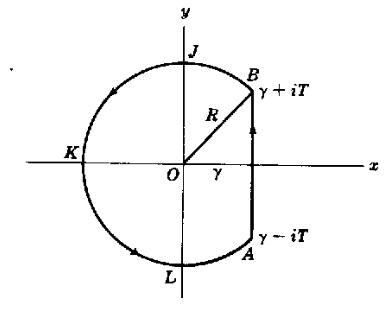
donde es el contorno de la figura 1. Este contorno, llamado contorno de Bromwich, se compone del segmento y el arco de una circunferencia de radio con cento en el origen .
Si se representa el arco como , debido a que (recordando el teorema de Pitágoras), la ecuación (1), se tiene que
– – – (3)
Figura 1 Contorno de Bromwich.
Estudio del contorno de Bromwich
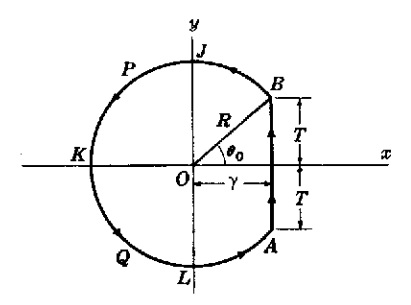
Sea la parte curva del contorno de Bromwich (figura 7.1.3) cuya ecuación es , , es decir, el arco de una circunferencia de radio y centro en el origen. Se va a suponer que sobre se verifica que
donde y son constantes.
Figura 2, Representando a Γ la parte curva BJPKQLA del contorno de Bromwich
Representando a , , y como los arcos , , y , se tiene que
Entonces, si se logra demostrar que cada una de las integrales del lado derecho tiende a cero cuando , se habrá demostrado el resultado requerido. Así que, se resolverán cada una de las integrales:
Análisis de la primera integral del miembro derecho.
Como , , , se tiene a lo largo de
Entonces
Tomando la condición dada (o mejor dicho, ) sobre
Y tomando la transformación [o mejor dicho ]
Ahora, como , resulta
Por tanto, para la primera integral
Análisis de la segunda integral del miembro derecho.
Como , , , se tiene a lo largo de
Entonces
Tomando la condición dada (o mejor dicho, ) sobre
Y tomando la transformación [o mejor dicho ]
Ahora, como para , resulta
Por tanto, para la segunda integral
De manera similar, para la tercera y cuarta integral
Dedicado a compartir información temas referentes al cálculo básicos, intermedios y avanzados mediante presentaciones PDF, videos y publicaciones en este sitio web.
Ver todas las entradas de Cesar Reyes
2 comentarios sobre “Fórmula de inversión compleja y el contorno de Bromwich. Laplace.”
Seria tan amable de escribir mejor las formulas no es legible
Hola Fernando. Las fórmulas están legibles, el formato con el que estoy utilizando trata de adaptarlo al zoom y al tamaño de la ventana de el navegador. Algunas fórmulas son un poco extensas, por lo que es posible que se visualice un poco desordenado. Por el momento no realizo este tipo de situaciones.
![F(s) = \mathcal{L}[f(t)]](https://s0.wp.com/latex.php?latex=F%28s%29+%3D+%5Cmathcal%7BL%7D%5Bf%28t%29%5D&bg=ffffff&fg=192930&s=0&c=20201002)
![\mathcal{L}^{-1}[F(s)]](https://s0.wp.com/latex.php?latex=%5Cmathcal%7BL%7D%5E%7B-1%7D%5BF%28s%29%5D&bg=ffffff&fg=192930&s=0&c=20201002)


![\displaystyle \frac{1}{2\pi i} \int_{\gamma - i \infty}^{\gamma + i \infty}{e^{st} \ F(s) \, ds} = \frac{1}{2\pi} e^{\gamma t} \int_{-\infty}^{\infty}{e^{iyt} \, dy} \int_{0}^{\infty}{e^{- i y u} [e^{- \gamma u} f(u)] \, du}](https://s0.wp.com/latex.php?latex=%5Cdisplaystyle+%5Cfrac%7B1%7D%7B2%5Cpi+i%7D+%5Cint_%7B%5Cgamma+-+i+%5Cinfty%7D%5E%7B%5Cgamma+%2B+i+%5Cinfty%7D%7Be%5E%7Bst%7D+%5C+F%28s%29+%5C%2C+ds%7D+%3D++%5Cfrac%7B1%7D%7B2%5Cpi%7D+e%5E%7B%5Cgamma+t%7D+%5Cint_%7B-%5Cinfty%7D%5E%7B%5Cinfty%7D%7Be%5E%7Biyt%7D+%5C%2C+dy%7D++%5Cint_%7B0%7D%5E%7B%5Cinfty%7D%7Be%5E%7B-+i+y+u%7D+%5Be%5E%7B-+%5Cgamma+u%7D+f%28u%29%5D+%5C%2C+du%7D&bg=ffffff&fg=192930&s=0&c=20201002)


![\displaystyle = \lim_{R \rightarrow \infty}{\left[ \frac{1}{2\pi i} \oint_{C}{e^{st} \ F(s) \, ds} - \frac{1}{2\pi i} \int_{\Gamma}{e^{st} \ F(s) \, ds} \right]}](https://s0.wp.com/latex.php?latex=%5Cdisplaystyle+%3D+%5Clim_%7BR+%5Crightarrow+%5Cinfty%7D%7B%5Cleft%5B+%5Cfrac%7B1%7D%7B2%5Cpi+i%7D+%5Coint_%7BC%7D%7Be%5E%7Bst%7D+%5C+F%28s%29+%5C%2C+ds%7D+-+%5Cfrac%7B1%7D%7B2%5Cpi+i%7D+%5Cint_%7B%5CGamma%7D%7Be%5E%7Bst%7D+%5C+F%28s%29+%5C%2C+ds%7D+%5Cright%5D%7D&bg=ffffff&fg=192930&s=0&c=20201002)




![\displaystyle \lim_{R \rightarrow \infty}{\int_{\Gamma}{e^{st} \ F(s) \, ds}} = \lim_{R \rightarrow \infty}{\left[\int_{\Gamma_1}{e^{st} \ F(s) \, ds} + \int_{\Gamma_2}{e^{st} \ F(s) \, ds} + \int_{\Gamma_3}{e^{st} \ F(s) \, ds} + \int_{\Gamma_4}{e^{st} \ F(s) \, ds} \right]}](https://s0.wp.com/latex.php?latex=%5Cdisplaystyle+%5Clim_%7BR+%5Crightarrow+%5Cinfty%7D%7B%5Cint_%7B%5CGamma%7D%7Be%5E%7Bst%7D+%5C+F%28s%29+%5C%2C+ds%7D%7D+%3D+%5Clim_%7BR+%5Crightarrow+%5Cinfty%7D%7B%5Cleft%5B%5Cint_%7B%5CGamma_1%7D%7Be%5E%7Bst%7D+%5C+F%28s%29+%5C%2C+ds%7D+%2B+%5Cint_%7B%5CGamma_2%7D%7Be%5E%7Bst%7D+%5C+F%28s%29+%5C%2C+ds%7D+%2B+%5Cint_%7B%5CGamma_3%7D%7Be%5E%7Bst%7D+%5C+F%28s%29+%5C%2C+ds%7D+%2B+%5Cint_%7B%5CGamma_4%7D%7Be%5E%7Bst%7D+%5C+F%28s%29+%5C%2C+ds%7D+%5Cright%5D%7D&bg=ffffff&fg=192930&s=0&c=20201002)


![\displaystyle \lim_{R \rightarrow \infty}{|I_1|} \le \lim_{R \rightarrow \infty}{\left[\frac{M}{R^{k-1}} e^{ \gamma t} \arcsin{\frac{\gamma}{R}} \right]}](https://s0.wp.com/latex.php?latex=%5Cdisplaystyle+%5Clim_%7BR+%5Crightarrow+%5Cinfty%7D%7B%7CI_1%7C%7D+%5Cle+%5Clim_%7BR+%5Crightarrow+%5Cinfty%7D%7B%5Cleft%5B%5Cfrac%7BM%7D%7BR%5E%7Bk-1%7D%7D+e%5E%7B+%5Cgamma+t%7D+%5Carcsin%7B%5Cfrac%7B%5Cgamma%7D%7BR%7D%7D+%5Cright%5D%7D&bg=ffffff&fg=192930&s=0&c=20201002)
![\displaystyle \lim_{R \rightarrow \infty}{\int_{\Gamma_1}{e^{st} \ F(s) \, ds}} \le \lim_{R \rightarrow \infty}{\left[\frac{M}{R^{k-1}} e^{ \gamma t} \arcsin{\frac{\gamma}{R}} \right]}](https://s0.wp.com/latex.php?latex=%5Cdisplaystyle+%5Clim_%7BR+%5Crightarrow+%5Cinfty%7D%7B%5Cint_%7B%5CGamma_1%7D%7Be%5E%7Bst%7D+%5C+F%28s%29+%5C%2C+ds%7D%7D+%5Cle+%5Clim_%7BR+%5Crightarrow+%5Cinfty%7D%7B%5Cleft%5B%5Cfrac%7BM%7D%7BR%5E%7Bk-1%7D%7D+e%5E%7B+%5Cgamma+t%7D+%5Carcsin%7B%5Cfrac%7B%5Cgamma%7D%7BR%7D%7D+%5Cright%5D%7D&bg=ffffff&fg=192930&s=0&c=20201002)


![\displaystyle = \frac{M}{R^{k-1}} \int_{0}^{\pi/2}{e^{-(\frac{2R \phi}{\pi}) t} \, d\phi} = \frac{M}{R^{k-1}} \cdot \left( - \frac{\pi}{2R t} \right) \left[e^{-(\frac{2R \cdot \frac{\pi}{2}}{\pi}) t} - 1 \right]](https://s0.wp.com/latex.php?latex=%5Cdisplaystyle+%3D+%5Cfrac%7BM%7D%7BR%5E%7Bk-1%7D%7D+%5Cint_%7B0%7D%5E%7B%5Cpi%2F2%7D%7Be%5E%7B-%28%5Cfrac%7B2R+%5Cphi%7D%7B%5Cpi%7D%29+t%7D+%5C%2C+d%5Cphi%7D+%3D+%5Cfrac%7BM%7D%7BR%5E%7Bk-1%7D%7D+%5Ccdot+%5Cleft%28+-+%5Cfrac%7B%5Cpi%7D%7B2R+t%7D+%5Cright%29+%5Cleft%5Be%5E%7B-%28%5Cfrac%7B2R+%5Ccdot+%5Cfrac%7B%5Cpi%7D%7B2%7D%7D%7B%5Cpi%7D%29+t%7D+-+1+%5Cright%5D&bg=ffffff&fg=192930&s=0&c=20201002)


![\displaystyle \lim_{R \rightarrow \infty}{|I_2|} \le \lim_{R \rightarrow \infty}{\left[\frac{\pi M}{2tR^{k}} \left(1 - e^{-R t} \right) \right]}](https://s0.wp.com/latex.php?latex=%5Cdisplaystyle+%5Clim_%7BR+%5Crightarrow+%5Cinfty%7D%7B%7CI_2%7C%7D+%5Cle+%5Clim_%7BR+%5Crightarrow+%5Cinfty%7D%7B%5Cleft%5B%5Cfrac%7B%5Cpi+M%7D%7B2tR%5E%7Bk%7D%7D+%5Cleft%281+-+e%5E%7B-R+t%7D+%5Cright%29+%5Cright%5D%7D&bg=ffffff&fg=192930&s=0&c=20201002)
![\displaystyle \lim_{R \rightarrow \infty}{\int_{\Gamma_2}{e^{st} \ F(s) \, ds}} \le \lim_{R \rightarrow \infty}{\left[\frac{\pi M}{2tR^{k}} \left(1 - e^{-R t} \right) \right]}](https://s0.wp.com/latex.php?latex=%5Cdisplaystyle+%5Clim_%7BR+%5Crightarrow+%5Cinfty%7D%7B%5Cint_%7B%5CGamma_2%7D%7Be%5E%7Bst%7D+%5C+F%28s%29+%5C%2C+ds%7D%7D+%5Cle+%5Clim_%7BR+%5Crightarrow+%5Cinfty%7D%7B%5Cleft%5B%5Cfrac%7B%5Cpi+M%7D%7B2tR%5E%7Bk%7D%7D+%5Cleft%281+-+e%5E%7B-R+t%7D+%5Cright%29+%5Cright%5D%7D&bg=ffffff&fg=192930&s=0&c=20201002)


Seria tan amable de escribir mejor las formulas no es legible
Me gustaMe gusta
Hola Fernando. Las fórmulas están legibles, el formato con el que estoy utilizando trata de adaptarlo al zoom y al tamaño de la ventana de el navegador. Algunas fórmulas son un poco extensas, por lo que es posible que se visualice un poco desordenado. Por el momento no realizo este tipo de situaciones.
Me gustaMe gusta