Introducción
Sea 


Problemas resueltos
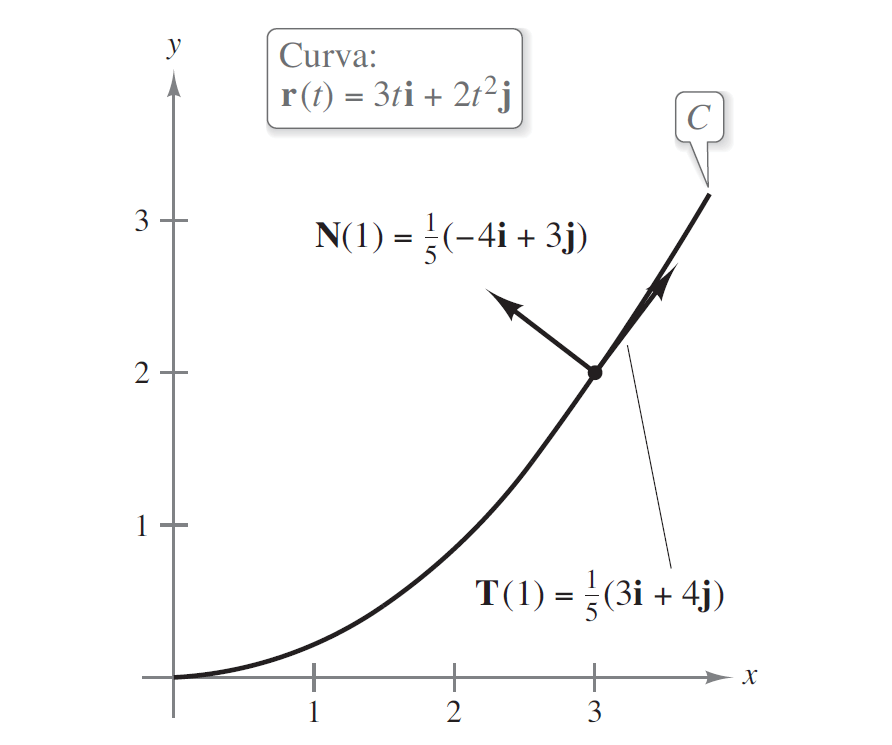
Problema 1. Encontrar 


Solución. De la función dada por el problema, se determina su primera derivada

![\displaystyle \frac{d}{dt} [\mathbf{r} (t)] = \frac{d}{dt} [3t \mathbf{i} + 2t^2 \mathbf{j}]](https://s0.wp.com/latex.php?latex=%5Cdisplaystyle+%5Cfrac%7Bd%7D%7Bdt%7D+%5B%5Cmathbf%7Br%7D+%28t%29%5D+%3D+%5Cfrac%7Bd%7D%7Bdt%7D+%5B3t+%5Cmathbf%7Bi%7D+%2B+2t%5E2+%5Cmathbf%7Bj%7D%5D&bg=ffffff&fg=192930&s=0&c=20201002)


Determinando su magnitud


Tomando la fórmula del vector unitario tangente y sustituyendo resulta lo siguiente


De este último resultado, se determina su primera derivada
![\displaystyle \frac{d}{dt} [\mathbf{T} (t)] = \frac{d}{dt} \left[\frac{1}{\sqrt{9 + 16t^2}} \left( 3 \mathbf{i} + 4t \mathbf{j} \right) \right]](https://s0.wp.com/latex.php?latex=%5Cdisplaystyle+%5Cfrac%7Bd%7D%7Bdt%7D+%5B%5Cmathbf%7BT%7D+%28t%29%5D+%3D+%5Cfrac%7Bd%7D%7Bdt%7D+%5Cleft%5B%5Cfrac%7B1%7D%7B%5Csqrt%7B9+%2B+16t%5E2%7D%7D+%5Cleft%28+3+%5Cmathbf%7Bi%7D+%2B+4t+%5Cmathbf%7Bj%7D+%5Cright%29+%5Cright%5D&bg=ffffff&fg=192930&s=0&c=20201002)
![\displaystyle \frac{d}{dt} [\mathbf{T} (t)] = \frac{d}{dt} \left[\frac{3 \mathbf{i} + 4t \mathbf{j}}{\sqrt{9 + 16t^2}} \right]](https://s0.wp.com/latex.php?latex=%5Cdisplaystyle+%5Cfrac%7Bd%7D%7Bdt%7D+%5B%5Cmathbf%7BT%7D+%28t%29%5D+%3D+%5Cfrac%7Bd%7D%7Bdt%7D+%5Cleft%5B%5Cfrac%7B3+%5Cmathbf%7Bi%7D+%2B+4t+%5Cmathbf%7Bj%7D%7D%7B%5Csqrt%7B9+%2B+16t%5E2%7D%7D+%5Cright%5D&bg=ffffff&fg=192930&s=0&c=20201002)

![\displaystyle \mathbf{T}' (t) = \frac{1}{{(\sqrt{9 + 16t^2})}^2} \left[(\sqrt{9 + 16t^2}) \frac{d}{dt} (3 \mathbf{i} + 4t \mathbf{j}) - (3 \mathbf{i} + 4t \mathbf{j}) \frac{d}{dt} (\sqrt{9 + 16t^2}) \right]](https://s0.wp.com/latex.php?latex=%5Cdisplaystyle+%5Cmathbf%7BT%7D%27+%28t%29+%3D+%5Cfrac%7B1%7D%7B%7B%28%5Csqrt%7B9+%2B+16t%5E2%7D%29%7D%5E2%7D+%5Cleft%5B%28%5Csqrt%7B9+%2B+16t%5E2%7D%29+%5Cfrac%7Bd%7D%7Bdt%7D+%283+%5Cmathbf%7Bi%7D+%2B+4t+%5Cmathbf%7Bj%7D%29+-+%283+%5Cmathbf%7Bi%7D+%2B+4t+%5Cmathbf%7Bj%7D%29+%5Cfrac%7Bd%7D%7Bdt%7D+%28%5Csqrt%7B9+%2B+16t%5E2%7D%29+%5Cright%5D&bg=ffffff&fg=192930&s=0&c=20201002)
![\displaystyle \mathbf{T}' (t) = \frac{1}{{(\sqrt{9 + 16t^2})}^2} \left[(\sqrt{9 + 16t^2}) (0 \mathbf{i} + 4 \mathbf{j}) - (3 \mathbf{i} + 4t \mathbf{j}) \frac{32t}{2\sqrt{9 + 16t^2}} \right]](https://s0.wp.com/latex.php?latex=%5Cdisplaystyle+%5Cmathbf%7BT%7D%27+%28t%29+%3D+%5Cfrac%7B1%7D%7B%7B%28%5Csqrt%7B9+%2B+16t%5E2%7D%29%7D%5E2%7D+%5Cleft%5B%28%5Csqrt%7B9+%2B+16t%5E2%7D%29+%280+%5Cmathbf%7Bi%7D+%2B+4+%5Cmathbf%7Bj%7D%29+-+%283+%5Cmathbf%7Bi%7D+%2B+4t+%5Cmathbf%7Bj%7D%29+%5Cfrac%7B32t%7D%7B2%5Csqrt%7B9+%2B+16t%5E2%7D%7D+%5Cright%5D&bg=ffffff&fg=192930&s=0&c=20201002)
![\displaystyle \mathbf{T}' (t) = \frac{1}{{(\sqrt{9 + 16t^2})}^2} \left[(\sqrt{9 + 16t^2}) (0 \mathbf{i} + 4 \mathbf{j}) \cdot \frac{\sqrt{9 + 16t^2}}{\sqrt{9 + 16t^2}} - (3 \mathbf{i} + 4t \mathbf{j}) \frac{16t}{\sqrt{9 + 16t^2}} \cdot \frac{\sqrt{9 + 16t^2}}{\sqrt{9 + 16t^2}} \right]](https://s0.wp.com/latex.php?latex=%5Cdisplaystyle+%5Cmathbf%7BT%7D%27+%28t%29+%3D+%5Cfrac%7B1%7D%7B%7B%28%5Csqrt%7B9+%2B+16t%5E2%7D%29%7D%5E2%7D+%5Cleft%5B%28%5Csqrt%7B9+%2B+16t%5E2%7D%29+%280+%5Cmathbf%7Bi%7D+%2B+4+%5Cmathbf%7Bj%7D%29+%5Ccdot+%5Cfrac%7B%5Csqrt%7B9+%2B+16t%5E2%7D%7D%7B%5Csqrt%7B9+%2B+16t%5E2%7D%7D+-+%283+%5Cmathbf%7Bi%7D+%2B+4t+%5Cmathbf%7Bj%7D%29+%5Cfrac%7B16t%7D%7B%5Csqrt%7B9+%2B+16t%5E2%7D%7D+%5Ccdot+%5Cfrac%7B%5Csqrt%7B9+%2B+16t%5E2%7D%7D%7B%5Csqrt%7B9+%2B+16t%5E2%7D%7D+%5Cright%5D&bg=ffffff&fg=192930&s=0&c=20201002)
![\displaystyle \mathbf{T}' (t) = \frac{1}{{(\sqrt{9 + 16t^2})}^2} \left[ \frac{(\sqrt{9 + 16t^2})^2}{\sqrt{9 + 16t^2}} \cdot (0 \mathbf{i} + 4 \mathbf{j}) - \frac{\sqrt{9 + 16t^2}}{(\sqrt{9 + 16t^2})^2} \cdot (48t \mathbf{i} + 64t^2 \mathbf{j}) \right]](https://s0.wp.com/latex.php?latex=%5Cdisplaystyle+%5Cmathbf%7BT%7D%27+%28t%29+%3D+%5Cfrac%7B1%7D%7B%7B%28%5Csqrt%7B9+%2B+16t%5E2%7D%29%7D%5E2%7D+%5Cleft%5B+%5Cfrac%7B%28%5Csqrt%7B9+%2B+16t%5E2%7D%29%5E2%7D%7B%5Csqrt%7B9+%2B+16t%5E2%7D%7D+%5Ccdot+%280+%5Cmathbf%7Bi%7D+%2B+4+%5Cmathbf%7Bj%7D%29+-+%5Cfrac%7B%5Csqrt%7B9+%2B+16t%5E2%7D%7D%7B%28%5Csqrt%7B9+%2B+16t%5E2%7D%29%5E2%7D+%5Ccdot+%2848t+%5Cmathbf%7Bi%7D+%2B+64t%5E2+%5Cmathbf%7Bj%7D%29+%5Cright%5D&bg=ffffff&fg=192930&s=0&c=20201002)
![\displaystyle \mathbf{T}' (t) = \frac{1}{{(\sqrt{9 + 16t^2})}^2} \left[ \frac{(9 + 16t^2)}{\sqrt{9 + 16t^2}} \cdot (0 \mathbf{i} + 4 \mathbf{j}) - \frac{1}{\sqrt{9 + 16t^2}} \cdot (48t \mathbf{i} + 64t^2 \mathbf{j}) \right]](https://s0.wp.com/latex.php?latex=%5Cdisplaystyle+%5Cmathbf%7BT%7D%27+%28t%29+%3D+%5Cfrac%7B1%7D%7B%7B%28%5Csqrt%7B9+%2B+16t%5E2%7D%29%7D%5E2%7D+%5Cleft%5B+%5Cfrac%7B%289+%2B+16t%5E2%29%7D%7B%5Csqrt%7B9+%2B+16t%5E2%7D%7D+%5Ccdot+%280+%5Cmathbf%7Bi%7D+%2B+4+%5Cmathbf%7Bj%7D%29+-+%5Cfrac%7B1%7D%7B%5Csqrt%7B9+%2B+16t%5E2%7D%7D+%5Ccdot+%2848t+%5Cmathbf%7Bi%7D+%2B+64t%5E2+%5Cmathbf%7Bj%7D%29+%5Cright%5D&bg=ffffff&fg=192930&s=0&c=20201002)
![\displaystyle \mathbf{T}' (t) = \frac{1}{{(\sqrt{9 + 16t^2})}^2} \cdot \frac{1}{{\sqrt{9 + 16t^2}}} \left[(9 + 16t^2) \cdot (0 \mathbf{i} + 4 \mathbf{j}) - (1) \cdot (48t \mathbf{i} + 64t^2 \mathbf{j}) \right]](https://s0.wp.com/latex.php?latex=%5Cdisplaystyle+%5Cmathbf%7BT%7D%27+%28t%29+%3D+%5Cfrac%7B1%7D%7B%7B%28%5Csqrt%7B9+%2B+16t%5E2%7D%29%7D%5E2%7D+%5Ccdot+%5Cfrac%7B1%7D%7B%7B%5Csqrt%7B9+%2B+16t%5E2%7D%7D%7D+%5Cleft%5B%289+%2B+16t%5E2%29+%5Ccdot+%280+%5Cmathbf%7Bi%7D+%2B+4+%5Cmathbf%7Bj%7D%29+-+%281%29+%5Ccdot+%2848t+%5Cmathbf%7Bi%7D+%2B+64t%5E2+%5Cmathbf%7Bj%7D%29+%5Cright%5D&bg=ffffff&fg=192930&s=0&c=20201002)
![\displaystyle \mathbf{T}' (t) = \frac{1}{{(\sqrt{9 + 16t^2})}^3} \left[0 \mathbf{i} + (36 + 64t^2) \mathbf{j} - 48t \mathbf{i} - 64t^2 \mathbf{j} \right]](https://s0.wp.com/latex.php?latex=%5Cdisplaystyle+%5Cmathbf%7BT%7D%27+%28t%29+%3D+%5Cfrac%7B1%7D%7B%7B%28%5Csqrt%7B9+%2B+16t%5E2%7D%29%7D%5E3%7D+%5Cleft%5B0+%5Cmathbf%7Bi%7D+%2B+%2836+%2B+64t%5E2%29+%5Cmathbf%7Bj%7D+-+48t+%5Cmathbf%7Bi%7D+-+64t%5E2+%5Cmathbf%7Bj%7D+%5Cright%5D&bg=ffffff&fg=192930&s=0&c=20201002)


Obteniendo la magnitud de este último resultado

![\displaystyle ||\mathbf{T}' (t)|| = \sqrt{{\left[\frac{12}{{(\sqrt{9 + 16t^2})}^3} \right]}^2 \cdot {(- 4t)}^2 + {\left[\frac{12}{{(\sqrt{9 + 16t^2})}^3} \right]}^2 \cdot {(3)}^2}](https://s0.wp.com/latex.php?latex=%5Cdisplaystyle+%7C%7C%5Cmathbf%7BT%7D%27+%28t%29%7C%7C+%3D+%5Csqrt%7B%7B%5Cleft%5B%5Cfrac%7B12%7D%7B%7B%28%5Csqrt%7B9+%2B+16t%5E2%7D%29%7D%5E3%7D+%5Cright%5D%7D%5E2+%5Ccdot+%7B%28-+4t%29%7D%5E2+%2B+%7B%5Cleft%5B%5Cfrac%7B12%7D%7B%7B%28%5Csqrt%7B9+%2B+16t%5E2%7D%29%7D%5E3%7D+%5Cright%5D%7D%5E2+%5Ccdot+%7B%283%29%7D%5E2%7D&bg=ffffff&fg=192930&s=0&c=20201002)
![\displaystyle ||\mathbf{T}' (t)|| = \sqrt{{\left[\frac{12}{{(\sqrt{9 + 16t^2})}^3} \right]}^2} \cdot \sqrt{{(- 4t)}^2 + {(3)}^2}](https://s0.wp.com/latex.php?latex=%5Cdisplaystyle+%7C%7C%5Cmathbf%7BT%7D%27+%28t%29%7C%7C+%3D+%5Csqrt%7B%7B%5Cleft%5B%5Cfrac%7B12%7D%7B%7B%28%5Csqrt%7B9+%2B+16t%5E2%7D%29%7D%5E3%7D+%5Cright%5D%7D%5E2%7D+%5Ccdot+%5Csqrt%7B%7B%28-+4t%29%7D%5E2+%2B++%7B%283%29%7D%5E2%7D&bg=ffffff&fg=192930&s=0&c=20201002)


Determinando el vector unitario normal, resulta que


Finalmente, el valor de 
![\displaystyle \mathbf{N} (1) = \frac{1}{\sqrt{9 + 16{(1)}^2}} \ \left[- 4(1) \mathbf{i} + 3 \mathbf{j} \right]](https://s0.wp.com/latex.php?latex=%5Cdisplaystyle+%5Cmathbf%7BN%7D+%281%29+%3D+%5Cfrac%7B1%7D%7B%5Csqrt%7B9+%2B+16%7B%281%29%7D%5E2%7D%7D+%5C+%5Cleft%5B-+4%281%29+%5Cmathbf%7Bi%7D+%2B+3+%5Cmathbf%7Bj%7D+%5Cright%5D&bg=ffffff&fg=192930&s=0&c=20201002)


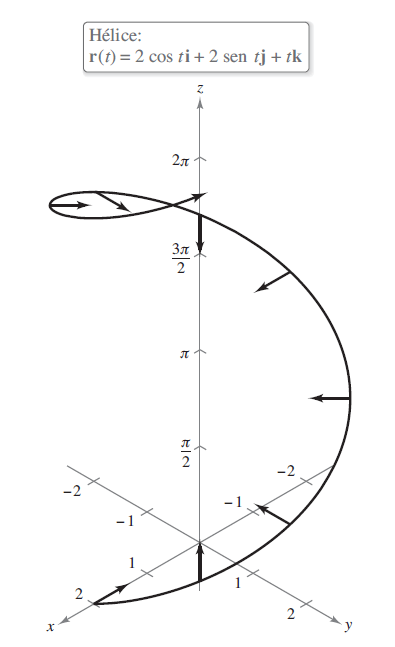
Problema 2. Encontrar el vector unitario normal principal para la hélice dada por 
Solución. Primero se determina la primera deriva de la función vectorial 
![\displaystyle \frac{d}{dt} [\mathbf{r} (t)] = \frac{d}{dt} [2 \cos{t}] \mathbf{i} + \frac{d}{dt} [2 \sin{t}] \mathbf{j} + \frac{d}{dt} [t] \mathbf{k}](https://s0.wp.com/latex.php?latex=%5Cdisplaystyle+%5Cfrac%7Bd%7D%7Bdt%7D+%5B%5Cmathbf%7Br%7D+%28t%29%5D+%3D+%5Cfrac%7Bd%7D%7Bdt%7D+%5B2+%5Ccos%7Bt%7D%5D+%5Cmathbf%7Bi%7D+%2B+%5Cfrac%7Bd%7D%7Bdt%7D+%5B2+%5Csin%7Bt%7D%5D+%5Cmathbf%7Bj%7D+%2B+%5Cfrac%7Bd%7D%7Bdt%7D+%5Bt%5D+%5Cmathbf%7Bk%7D&bg=ffffff&fg=192930&s=0&c=20201002)
![\displaystyle \mathbf{r}' (t) = 2 \frac{d}{dt} [\cos{t}] \mathbf{i} + 2 \frac{d}{dt} [\sin{t}] \mathbf{j} + \frac{d}{dt} [t] \mathbf{k}](https://s0.wp.com/latex.php?latex=%5Cdisplaystyle+%5Cmathbf%7Br%7D%27+%28t%29+%3D+2+%5Cfrac%7Bd%7D%7Bdt%7D+%5B%5Ccos%7Bt%7D%5D+%5Cmathbf%7Bi%7D+%2B+2+%5Cfrac%7Bd%7D%7Bdt%7D+%5B%5Csin%7Bt%7D%5D+%5Cmathbf%7Bj%7D+%2B+%5Cfrac%7Bd%7D%7Bdt%7D+%5Bt%5D+%5Cmathbf%7Bk%7D&bg=ffffff&fg=192930&s=0&c=20201002)

Después, se determina su magnitud


Tomando la fórmula de vector unitario tangentes y sustituyendo


De este último resultado se obtiene su primera derivada
![\displaystyle \frac{d}{dt} [\mathbf{T} (t)] = \frac{d}{dt} [\frac{1}{\sqrt{5}} (- 2 \sin{t} \mathbf{i} + 2 \cos{t} \mathbf{j} + \mathbf{k})]](https://s0.wp.com/latex.php?latex=%5Cdisplaystyle+%5Cfrac%7Bd%7D%7Bdt%7D+%5B%5Cmathbf%7BT%7D+%28t%29%5D+%3D+%5Cfrac%7Bd%7D%7Bdt%7D+%5B%5Cfrac%7B1%7D%7B%5Csqrt%7B5%7D%7D+%28-+2+%5Csin%7Bt%7D+%5Cmathbf%7Bi%7D+%2B+2+%5Ccos%7Bt%7D+%5Cmathbf%7Bj%7D+%2B+%5Cmathbf%7Bk%7D%29%5D&bg=ffffff&fg=192930&s=0&c=20201002)
![\displaystyle \mathbf{T}' (t) = - \frac{2}{\sqrt{5}} \frac{d}{dt} [\sin{t}] \mathbf{i} + \frac{2}{\sqrt{5}} \frac{d}{dt} [\cos{t}] + \frac{1}{\sqrt{5}} \frac{d}{dt} [1] \mathbf{k}](https://s0.wp.com/latex.php?latex=%5Cdisplaystyle+%5Cmathbf%7BT%7D%27+%28t%29+%3D+-+%5Cfrac%7B2%7D%7B%5Csqrt%7B5%7D%7D+%5Cfrac%7Bd%7D%7Bdt%7D+%5B%5Csin%7Bt%7D%5D+%5Cmathbf%7Bi%7D+%2B+%5Cfrac%7B2%7D%7B%5Csqrt%7B5%7D%7D+%5Cfrac%7Bd%7D%7Bdt%7D+%5B%5Ccos%7Bt%7D%5D+%2B+%5Cfrac%7B1%7D%7B%5Csqrt%7B5%7D%7D+%5Cfrac%7Bd%7D%7Bdt%7D+%5B1%5D+%5Cmathbf%7Bk%7D&bg=ffffff&fg=192930&s=0&c=20201002)


Y también su magnitud


Usando la fórmula del vector unitario normal principal y sustituyendo, resulta que



 Herramientas de cálculo